Monday, January 14, 2013

Remembering our 'rememberable' baptisms

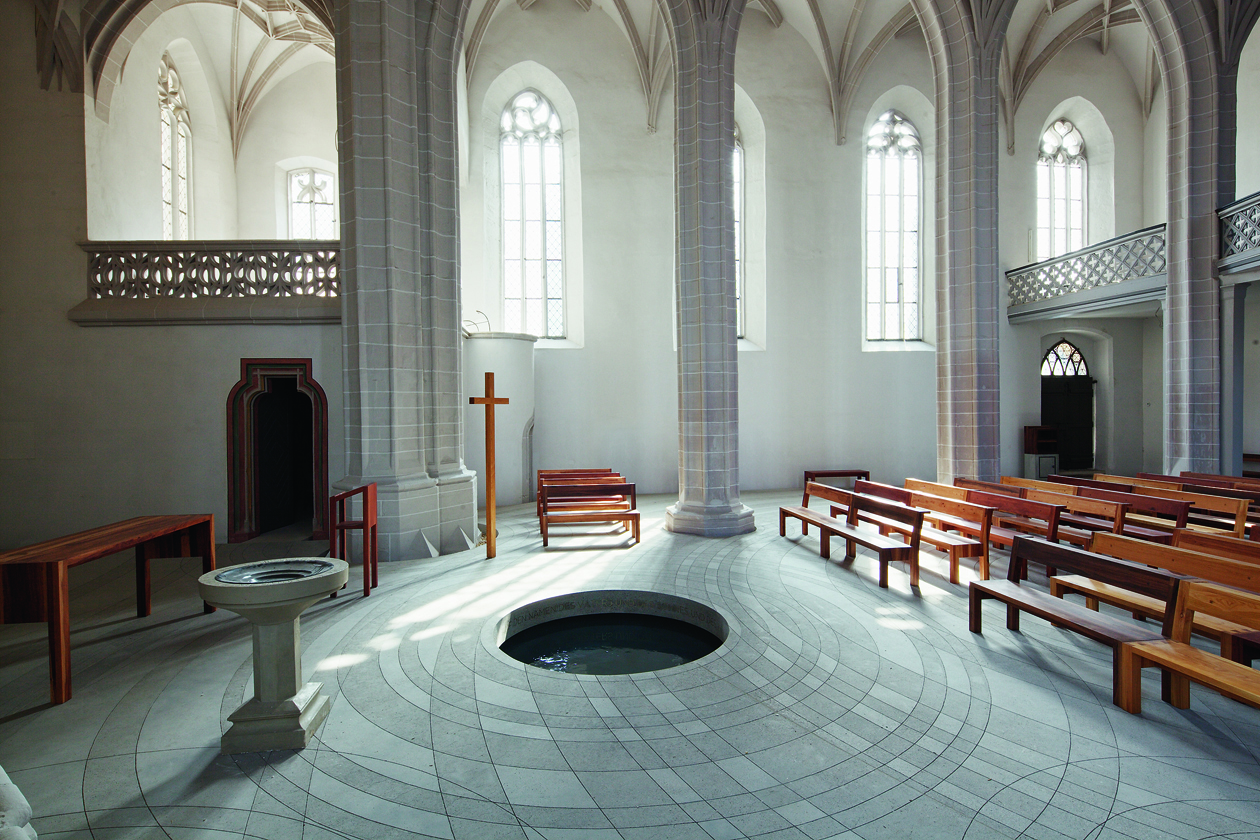
Church of St. Peter and St. Paul, Eisleben
A version of this post previously appeared on the ABPnews Blog.

Many churches celebrate the feast of the Baptism of the Lord on the Sunday following Epiphany (January 6). Since Epiphany falls on Sunday in 2013, this year the Baptism of the Lord was celebrated yesterday on January 13. This feast is an appropriate occasion for remembering our own baptisms, in which we took on a new ecclesial identity in Christ when we embraced Christ’s story, the story proclaimed by the church, as our story.

I recently found myself thinking about how churches in my own Baptist tradition might be more intentional about remembering our baptisms when I saw a photo posted on Facebook of a Lutheran baptism performed in a new immersion font in the Church of St. Peter and St. Paul in Eisleben, Germany—the church of Marin Luther’s baptism on November 11, 1483. Luther was baptized as an infant with water poured from a small font, remains of which were incorporated into a reconstructed font that now stands in the Church of St. Peter and St. Paul. But when the interior of the church was renovated in 2011, a new baptistry suitable for full-immersion baptisms was made the centerpiece of the renovated sanctuary. The top of the pool is level with the floor and is situated at the center of the front of the sanctuary, so that the congregation must look across the baptistry to see the altar and pulpit. Concentric circles in the pattern of the floor radiate outward from the baptistry. No one can worship there without thinking about baptism. On April 29, 2012, the Church of St. Peter and St. Paul was re-opened as the Center of Baptism for the Evangelical (Lutheran) Church in Germany intended to serve as a center for ecumenical reflection on the theology and practice of baptism.

One of the gifts that Baptist churches give to the people they baptize is a baptism that can be personally remembered. (I don’t think that candidates for membership in Baptist churches who were baptized as infants and have subsequently made the faith into which they were baptized their own should be required to be re-baptized with a “believer’s baptism” as a condition for membership, however, but that’s a topic for another discussion.) Baptists of all people have good reason to give attention to the remembrance of their 'rememberable' baptisms.

How might Baptists do this? I invite readers to share their own ideas and/or practices from their congregations in the comments below. I’ll start with the following recommendations:

  • Whenever someone is baptized, include in the worship service an opportunity for members of the congregation to re-commit themselves to their baptismal vows.
  • Regularly include recitation of the Apostles’ Creed (the baptismal creed of the Western church) and the Nicene Creed (the Eucharistic creed of the Western church and the baptismal and Eucharistic creed of the Eastern church) in worship services and call attention to their original role as baptismal confessions—declarations of the biblical story of the Triune God that we claim as our own in baptism. (I’ve explained elsewhere why Baptists can do this without betraying their Baptist heritage.)
  • Place a vessel of water drawn from the baptistry at the back of the sanctuary near the main entrance. Encourage members of the congregation to dip their fingers into it when entering and exiting the sanctuary as a reminder of their baptisms. With proper explanation given, they might also be encouraged to use the fingers dipped into the baptismal water to trace the sign of the cross upon their bodies as a reminder of their identification with Christ in baptism.
  • When the opportunity presents itself to build or re-design a worship space, design and situate the baptistry in such a way as to call attention to this practice so central to Baptist (and Christian) identity. Consider placing it near the main entrance to the worship space, so that worshipers pass by it when entering and exiting. Keep it filled with water, so that every worshiper may see and feel the water of baptism as a baptismal reminder each Sunday. (While I have not seen it in person, my friend Curtis Freeman tells me that the baptistry of the Olin T. Binkley Memorial Baptist Church in Chapel Hill, North Carolina, where he takes his Baptist House of Studies students at Duke Divinity School to practice performing baptism, is “one of the most baptistic baptistries in all Christendom.” It is at the back of the sanctuary, partly inside the sanctuary and partly inside the narthex. The chairs in the sanctuary are moveable and are turned to face the baptistry whenever baptism is part of a service of worship.)
What are your ideas for remembering our 'rememberable' baptisms? How has your congregation been intentional about baptismal remembrance?

Friday, January 11, 2013

Remembering our rememberable baptisms

My post "Remembering our rememberable baptisms" appears today on the Associated Baptist Press ABPnewsBlog. The full text will be posted on Ecclesial Theology early next week; in the meantime, here's a snippet from the beginning of the post:

Many churches celebrate the feast of the Baptism of the Lord on the Sunday following Epiphany (January 6). Since Epiphany falls on Sunday in 2013, this year the Baptism of the Lord is celebrated on January 13. This feast is an appropriate occasion for remembering our own baptisms, in which we took on a new ecclesial identity in Christ when we embraced Christ’s story, the story proclaimed by the church, as our story.

I recently found myself thinking about how Baptists might be more intentional about remembering our baptisms when I saw a photo posted on Facebook of a Lutheran baptism performed in a new immersion font in the Church of St. Peter and St. Paul in Eisleben, Germany—the church of Marin Luther’s baptism on November 11, 1483.... (read the full post at ABPnews Blog)

I hope readers of Ecclesial Theology will add their invited contributions to the comment thread on the post on the ABPnews Blog in response to the question posed in the post. At the very least, be sure to click on the link in the post to the photo of the "new baptistry suitable for full-immersion baptisms" in the church of Luther's baptism in Eisleben.

Thursday, January 10, 2013

3 recommendations for B/baptist bibliophiles for 2013

A version of this post appeared on the ABPnews Blog.

In 1500 Dutch humanist and theologian Desiderius Erasmus wrote to a friend, “When I get a little money I buy books; and if any is left I buy food and clothes.” Thanks to gift cards from Amazon or Barnes and Noble and/or undesignated gifts of Christmas cash, many Baptist (and baptist) bibliophiles among the readers of Ecclesial Theology are currently in a somewhat more comfortable position for expanding their libraries without resorting to such ascetic extremes.

How to spend this windfall? Here are three recommendations of books published in the last half of 2012 that are worth reading in 2013. (I’ve linked each title to the book’s page on its publisher’s web site; readers can also easily find them via amazon.combarnesandnoble.com, and other online booksellers.)
James Wm. McClendon, Jr., Systematic Theology, 3 vols., reprint edition with new introduction by Curtis W. Freeman (Waco, Tex.: Baylor University Press, 2012). The three-volume Systematic Theology by James Wm. McClendon, Jr. (1924-2000), published originally by Abingdon Press 1986-2000, is the most significant such work by a Baptist theologian to date. No Baptist minister or theologically-interested Baptist layperson should go without reading it. In hisSystematic Theology McClendon listened deeply to the Baptist tradition, the larger free church tradition (“baptists” with a lower-case “b” in McClendon’s usage), and to the tradition of the whole church to which Baptists and baptists belong on the way to offering a creative and compelling articulation of the ethics (volume 1), doctrine (volume 2), and witness (volume 3) of this concrete ecclesial community of reference. It’s the first thing I mention whenever students and ministers ask me what I think they ought to read. Baylor University Press has now re-issued McClendon’sSystematic Theology with a helpful 32-page introduction to McClendon’s thought by Curtis W. Freeman included at the beginning of each of the three volumes. I’m using the Baylor University Press edition of the Doctrine volume as a required core text in the Spring 2013 offerings of my Introduction to Christian Theology I and II courses at Gardner-Webb University School of Divinity.
E. Glenn Hinson, A Miracle of Grace: An Autobiography (Macon, Ga.: Mercer University Press, 2012). In my experience, theologically-reflective autobiography serves well as devotional literature. A Miracle of Grace by E. Glenn Hinson, Emeritus Professor of Spirituality and John Loftis Professor of Church History at Baptist Theological Seminary at Richmond and professor of church history at The Southern Baptist Theological Seminary for over three decades, fulfilled that function for me in a deeply meaningful way. As a Baptist theologian working in patristic theology and ecumenical theology I was keenly interested in Hinson’s account of those dimensions of his scholarly career. But as I devoured the book it occurred to me that features of Hinson’s journey are parallel to and instructive for three needs that have emerged in the shared journey of the Cooperative Baptist Fellowship, the ecclesial community with which both Hinson and I identify: (1) the early need to resist the sort of fundamentalism that came to dominate the Southern Baptist Convention; (2) the need to move beyond an identity defined by anti-fundamentalism and the maintenance of denominational distinctiveness toward a deeper spirituality; and (3) the need to embrace the whole church, past and present, as the source of the resources Baptist communities require for moving toward and sustaining this deeper spirituality. As a Baptist who has found many such resources in the Anglican tradition, I had special appreciation for this passage from the book:
A lot of Baptists may fail to recognize it, but the Church of England is our mother church by way of the Puritans. A Baptist joining an Anglican or Episcopal church is going home….Each year since January 2004, I have delivered a series of four or five lectures to the Adult Forum of Christ Church Cathedral [in Lexington, Kentucky]. Each time I lectured, I tried to remain for the morning Eucharist, and I must confess that returning to a Baptist congregation left me feeling unfulfilled spiritually. Baptists speak about the Bible a great deal, but they do not saturate their worship with it in the same way the Anglican liturgy does! I understand well why some of my most discerning friends have become Episcopalians (pp. 355-56).
One of the lessons of Hinson’s book is that no Baptist has to become Episcopalian—or Orthodox, Catholic, or any other Christian tradition—in order to find these resources, for as Hinson insists, Baptists belong to the whole church, and the whole church belongs to Baptists.
Jeffrey W. Cary, Free Churches and the Body of Christ: Authority, Unity, and Truthfulness (Free Church, Catholic Tradition; Eugene, Ore.: Cascade Books, 2012). Jeffrey Cary is not a Baptist, but as a Church of Christ theologian who serves as Assistant Professor of Theology at Lubbock Christian University in Lubbock, Texas, he is a McClendon lower-case “b” baptist who is appreciative of McClendon’s articulation of the baptist vision and seeks the renewal of his own ecclesial community by embracing the resources of the larger Christian tradition in ways I imagine Hinson would applaud. The first volume in the new Free Church, Catholic Tradition series launched by Cascade Books, Cary’s book is a revision of his doctoral dissertation at Baylor University. I provided this commendation for the back cover of Cary’s book and offer it to readers of the ABPnews Blog as well: “No advocate or critic of the current quest in the free church tradition for a fuller catholicity and deeper commitment to the visible unity of the church catholic should proceed further in reflecting on this movement without reading, marking, and inwardly digesting this agenda-setting book.”

Tuesday, January 8, 2013

Three ways to spend Christmas book money

My post "Three ways to spend Christmas book money" appeared on the Associated Baptist Press ABPnews Blog yesterday. I'll post the full text here on Ecclesial Theology in a couple of days; meanwhile here's a snippet from the beginning of the post:

In 1500 Dutch humanist and theologian Desiderius Erasmus wrote to a friend, “When I get a little money I buy books; and if any is left I buy food and clothes.” Thanks to gift cards from Amazon or Barnes and Noble and/or undesignated gifts of Christmas cash, many bibliophiles among the readers of the ABPnews Blog are currently in a somewhat more comfortable position for expanding their libraries without resorting to such ascetic extremes.

How to spend this windfall? Here are three recommendations of books published in the last half of 2012 that are worth reading in 2013 by the Associated Baptist Press constituency... (continue reading post on the ABPnews Blog)

Thursday, January 3, 2013

2013 Robert K. Campbell Lectures on Christian Unity theme

Last month I received an invitation to deliver the 2013 Robert K. Campbell Memorial Lectures on Christian Unity sponsored by the Lehigh County Conference of Churches and hosted by DeSales University in Center Valley, Pennsylvania on March 12. After mulling over possible directions for the lectures during Christmas break, I've now committed to an overarching theme and topics for the individual lectures:

Theme: The Pilgrim Church and the Ecumenical Future

Lecture 1: "The Dialogical Theology of a Pilgrim Church"

Lecture 2: "Toward a Narrative-Christological Ecclesiology"

I'm honored and humbled to be invited to contribute to this annual lecture series, which has featured such past lecturers as Avery Cardinal Dulles, Gabriel Fackre, Paul Crow, Michael Kinnamon, and Walter Cardinal Kasper.

Friday, December 28, 2012

In good company (or, the futility of theodicy)

Eloi, Eloi, Lama Sabachthani?
by Ann Kim
A version of this post was previously published on the ABPnews Blog maintained by Associated Baptist Press.
Today, the fourth day of Christmas, is the Feast of the Holy Innocents--a feast invested with special significance this year. It was the innocence of the twenty youngest victims of the Sandy Hook Elementary School shootings, all the ages of my son and his first-grade classmates, which made this latest mass shooting most enduringly haunting.
Their innocence also underscores the incapacities of the major approaches to theodicy for offering a satisfying resolution to the tension between Judeo-Christian affirmations of the goodness and omnipotence of God on the one hand and the ongoing existence of evil and suffering in God’s world on the other.
“Theodicy,” literally a “justification of God” in relation to the observation that all is not right with the present state of the world, is a philosophical legacy of the Enlightenment (Gottried Leibniz first employed the term in 1710). But the questions a theodicy seeks to answer are as old as humanity, for many ancient religions and philosophical systems represent attempts to answer them.
In antiquity and modernity, Christian thinkers have proposed various ways of relating what they affirm about the character of God to the sufferings that mark life in God’s world. Many in the Christian tradition have concurred with Augustine of Hippo (354-430), for whom humanity is to blame for the way things are: people use their God-given freedom to choose evil rather than good, and innocent people suffer as a result. Yet over two centuries earlier Irenaeus of Lyons (ca. 115-ca. 202) seemed to suggest that the possibility of suffering was part of God’s good creation from the beginning as necessary for helping people grow toward everything God intended humanity to be, a suggestion developed more fully in recent years by John Hick (1922-2012).
The Reformed tradition exemplified by John Calvin (1509-64) offered a twofold answer: God makes use of some instances of suffering to punish the wicked and discipline God’s people; in all instances God has a good purpose for suffering, but we cannot understand God’s purposes this side of heaven. (Echoes of this perspective are discernible in the public responses of some prominent American evangelicals to the tragedy in Newtown.) Others have proposed that the present state of the world is best explained in terms of a limitation of God’s omnipotence that is either constitutional or volitional—that is, either God is the sort of God that cannot do anything about innocent suffering, or else God can but chooses to be the sort of God that never overrides the free choices of people and their consequences.
In the wake of December 14, such ancient and modern proposals seem insufficient or even outrageously indecent when we use them to try to wrap our minds around our imaginings of what happened inside two first grade classrooms.
People of faith have been trying to wrap their minds around the reality of innocent suffering for a long time. The biblical book of Job portrays its main character as “blameless and upright, one who feared God and turned away from evil.” The book of Job tells a story inspired by a question: what if a completely innocent person were to suffer unjustly?
It’s a question that calls into question a common assumption of ancient near eastern people: if you do good, God will reward you with health and wealth, peace and security, and a long life. The corollary of that is that if you’re sick or poor or suffering the effects of a natural disaster or dying an untimely death, it must be that you’ve done something wrong and God is punishing you.
That’s not just an ancient assumption. If an earthquake produces a tsunami that kills hundreds of thousands of people in Southeast Asia, it must be because those people didn’t worship the right God. If a hurricane floods a gulf coast city and kills almost 2,000 people, it must be that that the people of that city did evil. If a tornado strikes a convention center while a church denominational convention is meeting there, it must be that God is giving them a warning because they welcome the wrong sorts of people into their churches. If an earthquake levels the cities of an impoverished Caribbean country, it must be because its citizens engaged in witchcraft. And it wasn’t long into the afternoon of December 14 before someone with access to a media megaphone blamed the deaths of twenty young children on America’s supposed “removal” of God from public schools.
Many of the people of God thought like that in the aftermath of the destruction of Jerusalem and its Temple and the deportation of its citizens to Babylon in 586 BC, which seems to be the time when Job’s story came to be written. But might it be possible that one could live an upright life and still suffer? If that’s the case, what does that say about God and God’s relationship with us?
Job is blameless and upright, one who fears God and turns away from evil—and yet the very things thought to befall the evil as punishment for sin happen to Job. He loses his family and flocks and fields; he loses his health; he falls into deep depression and feels abandoned by the God who to him is silent. Job’s very name means “enemy” in Hebrew, and he comes to see himself as God’s enemy because of his suffering and God’s silence. If good Job experiences such suffering, maybe no one’s exempt.
Yet the role Job plays in this story isn’t fully embodied by Job himself. Job may approximate blamelessness and uprightness, but Jesus is right: “No one is good except God alone” (Mark 10:18) There’s a sense in which Jesus is the “real Job,” a concept the late Baptist theologian James Wm. McClendon, Jr. developed in his Systematic Theology in a section critical of modern theodicies. Unlike Job, Jesus is perfectly blameless and perfectly upright, fully fearing God and turning away from evil without exception. And even Jesus, the “real Job,” the only perfectly blameless and upright person who has ever lived, suffers. If even this one suffers, no one is exempt. It is the reality of our world.
During Holy Week many Christians give voice to the reality of our world with a Good Friday recital of Psalm 22. Its opening words are Jesus’ final words from the cross in Mark’s version of the story: “My God, my God, why have you forsaken me?” Yet Christians have found various ways to distance good Jesus from what those words mean at face value. Some point out that later in Psalm 22 the psalmist does declare trust in God, and they suppose that by quoting from the beginning of that Psalm, Jesus is really invoking the entirety of the psalm and its expression of trust in God. But that’s not the part Jesus quotes. Some see this cry as suggesting that in this moment Jesus is bearing the sins of the world and that God the Father, who is holy and supposedly cannot look upon sin, turns his back on Jesus. There are all sorts of problems with that take on Jesus’ cry: nowhere does the text even remotely hint at anything like that, and that interpretation has all manner of problematic implications for how God relates to sinful people like us in our suffering. No, Jesus’ words must mean what they say: they express the paradox that God in the flesh has become God-forsaken. God has fully experienced the God-forsaken feeling of suffering people like Job, who sense in their suffering only God’ silence and absence.
One of my favorite artistic renderings of Jesus’ crucifixion is a 1998 painting by Korean-American artist Ann Kim. Her painting is titled “Eloi, Eloi, Lama Sabachthani,” Jesus’ cry from Psalm 22 in the Aramaic language Jesus spoke. The painting is striking in its perspective—most depictions of Jesus on the cross look at Jesus from below, standing on the ground looking up at Jesus hanging on the cross. Ann Kim’s painting looks down on the cross from above. It’s a God’s-eye view of the cross, looking down on an expressionistically-painted, ghost-like naked and hairless figure, face desperately straining toward heaven, sunken eyes wide with terror, and mouth gaping open in a scream that evokes the expression in Edvard Munch’s famous 1893 painting “The Scream”—which many have seen as Munch’s portrayal of the cry of modern humanity, for whom God is dead with nothing to replace God. Kim’s God’s-eye painting of Jesus’ scream “My God, my God, why have you forsaken me?” does justice to Jesus’ God-forsaken agony.
Where was God in Jesus’ God-forsaken agony? Not turning God’s back, not refusing to look on the sin Jesus bore, but precisely with Jesus. Indeed, the suffering Jesus is God. If we believe that Jesus is fully divine and fully human, that doesn’t cease to be true on the cross. The fully divine and fully human Jesus experiences fully the sufferings of the cross and fully suffers them as God—and so God fully does with us in our suffering. The Holy Spirit that is God’s perpetual presence everywhere in the world is also in particular fully present with Jesus in his sufferings and fully experiences his sufferings, just as the Holy Spirit that dwells within us fully does with us in our suffering. The God who is Father, Son, and Holy Spirit is made known to us in Jesus Christ, who according to the author of Hebrews “sympathizes”—“suffers with”— us.
What we Christians have isn’t a solution to the problem of evil and suffering, but a response. It’s the response of the Triune God to the reality of a suffering world. God responds by being fully present with that world, suffering with that world, lamenting the God-forsaken experience of that world and doing something about it. It’s also the response of God’s people, who are called to do what God does: to be present with suffering people, suffer with suffering people, and lament their seemingly God-forsaken suffering—which is to agree with God’s perspective on the injustice of their experience and to join God in doing something about the injustice of their lot in life.
In the Job story, Job’s friends don’t get a terribly sympathetic portrayal. When they hear of Job’s suffering they come to be with him, but they feel compelled to say something, and when they do it’s not very helpful. (There’s a lot of that going around.) They’re sure Job must have done something to bring such suffering on himself, and they tell him so. But something else Job’s friends do is underappreciated: Job’s friends were with Job when everyone else had abandoned him. And that’s all we have to do: we don’t have to have the right thing to say to help people in their suffering (though we can assure them God is with them and joins them in their suffering). All we have to do is be with them, and when we do so we embody the presence of God. And if we are with them, we will share their suffering, and we’ll find ourselves crying out to God in lament over it and motivated to do something to join God in working against its causes.
When people suffer, they’re in good company. They’re in the company of Job, who was renowned as good and suffered anyway. They’re in the company of Jesus, who was perfectly good, and suffered anyway. They’re in the company of the Triune God, who suffers as Father, Son, and Holy Spirit in the sufferings of the cross and in the sufferings of everyone, who laments their sufferings and works against the causes of their sufferings. When people suffer, Christians are called to be part of that good company as the body of Christ on earth.
That’s how God and God’s people respond to the sufferings of this present world. It’s not a theodicy, but something much better: it’s the Good News.

Friday, December 21, 2012

Musings on theodicy after Sandy Hook

My blog post "In good company (or, the futility of theodicy)" appears today on the ABPnews Blog hosted by Associate Baptist Press. Next week I'll post the full text here on Ecclesial Theology. In the meantime, here's an excerpt:

It was the innocence of the twenty youngest victims of the Sandy Hook Elementary School shootings, all the ages of my son and his first-grade classmates, which made this latest mass shooting most enduringly haunting.

Their innocence also underscores the incapacities of the major approaches to theodicy for offering a satisfying resolution to the tension between Judeo-Christian affirmations of the goodness and omnipotence of God on the one hand and the ongoing existence of evil and suffering in God’s world on the other... (read the full post on the ABPnews Blog)

Tuesday, December 11, 2012

The Saint Who Would Be Santa Claus

Ecclesial Theology is a little late in calling attention to the most recent book by my former Campbell University colleague and fellow Texas native (and North Carolina transplant) Adam C. English, having been preceded by significant media notices and interviews that have included The Wall Street Journal, Fox News, the Chronicle of Higher Education, and North Carolina Public Radio. Readers of this blog who weren't yet aware of The Saint Who Would Be Santa Claus: The True Life and Trials of Nicholas of Myra (Baylor University Press, 2012) will want to check out the book's web site and order a copy. The Saint Who Would Be Santa Claus establishes Dr. English as a scholar of wide-ranging interests who communicates the import of his research compellingly to the contemporary church and its culture, provides yet more evidence that Baylor University Press has emerged as an academic publisher that successfully advances first-rate scholarship in a trade market, and furthers the trajectory of Baptist theological work that engages the tradition of the whole church as the heritage of Baptists and all other Christians.

Monday, December 10, 2012

40 Great Books on Missional-Ecumenism

I'm grateful to John H. Armstrong and the Act 3 Network for including my book Ecumenism Means You, Too: Ordinary Christians and the Quest for Christian Unity (Eugene, Ore.: Cascade Books, 2010) in the organization's recommended list of books on the church, mission, and unity: "40 Great Books on Missional-Ecumenism."

Interested in reading Ecumenism Means You, Too? Order the book directly from the publisher or via Amazon (paper and Kindle formats available).

Friday, December 7, 2012

Ambrose of Milan, Advent hymns, Charles Wesley, individual eschatology, and ecumenism

5th-century (or possibly contemporary?)
mosaic, Basilica of St. Ambrose, Milan
Can a brief blog post possibly tie all those things together?

Today (December 7) is the feast day of St. Ambrose of Milan (ca. 339-397), regarded by many as the "father of Christian hymnody" due to his role in popularizing the singing of metrical liturgical hymns in the Western church. I've frequently invoked Ambrose's hymns in my Christian Theology courses to illustrate the lex orandi, lex credendi ("rule of praying, rule of believing)" principle of the coinherence of the church's liturgy and theology, for he composed numerous hymns that reinforced Nicene orthodoxy at a time when its reception in Northern Italy was in doubt. Many of these hymn texts are included in the hymnals of various Christian denominational traditions today, including the Advent hymn "Savior of the Nations, Come" that was later popularized through a German translation of its Latin text by none other than Martin Luther. (My personal favorite Ambrosian hymn in English translation is "O Splendor of God's Glory Bright," a recent choral setting of which may be heard here.)

Speaking of Advent hymns, yesterday evening I continued my custom of introducing the unit on "individual eschatology" in my Christian Theology II course with Charles Wesley's hymn "Lo! He Comes with Clouds Descending" (a nice choral rendition of the hymn by the Lichfield Cathedral Choir may be heard here). It's one of the few eschatologically-themed hymns included in North American evangelical hymnals that treat the return of Christ in terms broader than the occasion for eternal life in heaven, and its stanzas help the class place individual eschatology within the context of the preceding unit on cosmic eschatology.

For the past five years the singing of that hymn has powerfully recalled to my mind one of the most meaningful ecumenical gatherings in which I've ever participated. The December 2007 meeting of the Baptist World Alliance-Roman Catholic Church international theological conversations in Rome coincided with an ecumenical worship service at the Basilica of Saint Paul Outside the Walls in honor of the 300th anniversary of the birth of Charles Wesley. The members of the Baptist and Catholic delegations were privileged to attend this service at which both Walter Cardinal Kasper (then President of the Pontifical Council for Promoting Christian Unity) and Methodist theologian Geoffrey Wainwright spoke and during which we sang several of Wesley's hymns, including the well-known "Love Divine, All Loves Excelling" as well as "Lo! He Comes with Clouds Descending." We were reminded that something Baptists and Catholics share in common today, beyond many other things we discussed that week, is our mutual reception of the heritage of Wesleyan hymnody in our services of worship.

With controversy over language regarding the participation of the Jews in the crucifixion of Jesus in a proposed text for a renewed Latin Tridentine rite mass very much in the news then, as we walked from the Basilica back to our bus after that service several of us were discussing the seeming anti-Semitic overtones in the second stanza of "Lo! He Comes with Clouds Descending." As I suggested to my students last evening, while it's probable that Wesley had the Jews in mind in the second stanza ("Those who set at naught and sold him / Pierced and nailed him to the tree / Deeply wailing... / Shall their true Messiah see"), it's also possible to hear stanzas two and three as referring to the same group of people: for we, sinful yet redeemed humanity, are simultaneously "those who set at naught and sold him" and "his ransomed worshipers" whose twofold response to the coming of the Lord is both "deep wailing" and "endless exultation." For what it's worth.