Thursday, September 30, 2010

Communique from the latest round of Roman Catholic/Eastern Orthodox dialogue

Earlier this week the most recent round of conversations between the Roman Catholic Church and the Eastern Orthodox Churches concluded in Vienna, Austria. While each of the ongoing bilateral dialogues between divided Christian world communions is significant, the Catholic-Orthodox dialogue is especially significant for two reasons: (1) the Great Schism of 1054 is the first of the major historic fractures in the unity of the church (though patristic exceptions to full visible unity were certainly numerous), and (2) so little stands in the way of full communion between the two churches. This round of conversations seems to have been devoted to the continued exploration of the implications of a common agreement reached at a previous meeting of the dialogue commission in 2007 at Ravenna regarding the status of the bishop of Rome as "most senior bishop." Below is the text of the official communique released at the conclusion of the Vienna conversations:

Vienna, Austria--The twelfth meeting of the Joint International Commission for Theological Dialogue between the Orthodox Church and the Roman Catholic Church took place in Vienna, Austria, a city with a long history, a bridge between West and East, with a rich ecumenical life. The meeting, generously and fraternally hosted by the Roman Catholic Archdiocese of Vienna, from 20-27 September 2010, in the Kardinal König Haus.

Twenty three Catholic members were present, a few were unable to attend. All the Orthodox Churches, with the exception of the Patriarchate of Bulgaria, were represented, namely the Ecumenical Patriarchate, the Patriarchate of Alexandria, the Patriarchate of Antioch, the Patriarchate of Jerusalem, the Patriarchate of Moscow, the Patriarchate of Serbia, the Patriarchate of Romania, the Patriarchate of Georgia, the Church of Cyprus, the Church of Greece, the Church of Poland, the Church of Albania and the Church of the Czech Lands and Slovakia.

The Commission worked under the direction of its two co-presidents, Archbishop Kurt Koch and Metropolitan Prof. Dr John of Pergamon, assisted by the co-secretaries, Metropolitan Prof. Dr Gennadios of Sassima (Ecumenical Patriarchate) and Rev. Andrea Palmieri (Pontifical Council for Promoting Christian Unity).

At the opening plenary session on Wednesday, 22 September, the Commission was welcomed very warmly by the host, Cardinal Christoph Schönborn of Vienna, and by Metropolitan Michael of Austria of the Ecumenical Patriarchate on behalf of all Orthodox Churches present in Austria. Both emphasized the importance of holding the meeting in Vienna, which occupies a particular place in the history of the whole of Christianity. In the evening a reception was given by the Mayor of Vienna, Dr. Michael Häupl, at the Vienna Town Hall. The co-presidents announced that His Holiness Pope Benedict XVI had urged intense prayer for the Commission meeting at his Wednesday General Audience and they read a Message to the participants from His All Holiness the Ecumenical Patriarch Bartholomew. A letter was sent by the co-presidents on behalf of the Joint Commission to the former President of the Pontifical Council for Promoting Christian Unity and co-president of the dialogue, Cardinal Walter Kasper, expressing gratitude and appreciation for his service and for his significant contribution.

On Thursday, 23 September, the Ecumenical Council of Churches in Austria met the members of the Joint Commission at Kardinal König Haus. On Saturday, 25 September, the Catholic members celebrated the Eucharist in the Stephansdom in Vienna presided over by Cardinal Christoph Schönborn, in the presence of the Orthodox members. In his homily he said that "we have and we need a primacy in the canonical sense, but above all there is the primacy of charity. All canonical dispositions in the Church serve this primacy of love (agape)". Afterwards a reception was offered in the Courtyard of the Archiepiscopal Palace of Vienna.

On Sunday, 26 September, the Orthodox members celebrated the Divine Liturgy in the Cathedral of the Holy Trinity of the Greek Orthodox Metropolitanate of Austria in Vienna, presided over by Metropolitan John of Pergamon, in the presence of the Catholic members. In addressing those present, Metropolitan Michael of Austria conveyed "the greetings of the Ecumenical Patriarch Bartholomew and underlined the role and the contribution of the Greek Metropolitanate to the history of Vienna with great eminent personalities". He also referred to "the close collaboration between Orthodox and Catholics in Austria and in Vienna in particular, expressing the wish that the Lord's prayer 'that all may be one' (Jn 17:21) be a reality in the search for the unity of His Church".

During the afternoon, the members paid a visit to the Cistercian Abbey of Heiligenkreuz and attended the service of Vespers. Later in the evening, they visited the Russian Orthodox Cathedral of St. Nikolaus.

On the first day of the meeting, as is customary, the Roman Catholic and Orthodox members met separately to coordinate their work. The Orthodox meeting discussed among other things the unfinished draft text produced by the 11th plenary session in Paphos, Cyprus last year, and much time was given to the methodology of the dialogue. The Catholic meeting also considered the draft text, seeking specific ways to improve the text, and reflected on methodological questions.

As was decided at the 10th plenary session in Ravenna, 2007, the Commission is studying the theme "The Role of the Bishop of Rome in the Communion of the Church in the First Millennium", on the basis of a draft text prepared by the Joint Coordinating Committee, which met in Aghios Nikolaos/Crete, Greece, 2008. During its meeting in Vienna, the Commission continued the detailed consideration of the text which began at last year's plenary session at Paphos, Cyprus. At this stage, the Commission is discussing this text as a working document and it decided that the text must be further revised. It was also decided to form a sub-commission to begin consideration of the theological and ecclesiological aspects of Primacy in its relation to Synodality. The sub-commission will submit its work to the Joint Coordinating Committee of the Commission which will meet next year.

During the meeting the members received the sad news that Mgr Eleuterio Fortino, co-secretary of the Joint Commission since its inception, passed away, after a long period of illness, and prayers were offered for the repose of his soul.

The meeting of the Joint Commission was marked by a spirit of friendship and trustful collaboration. All members greatly appreciated the generous hospitality of the host Church, and they strongly commend the continuing work of the dialogue to the prayers of the faithful.

Wednesday, September 29, 2010

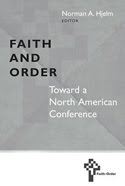
Introductions to ecumenism--Norman A. Hjelm (ed.), Faith and Order: Toward a North American Conference

Resuming a series of posts calling attention to selected resources featured in Appendix 1, "Resources for Ecumenical Engagement," in Ecumenism Means You, Too: Ordinary Christians and the Quest for Christian Unity (Cascade Books, 2010):

Norman A. Hjelm (ed.), Faith and Order: Toward a North American Conference. Study Guide (Grand Rapids, MI: William B. Eerdmans, 2005). This small book (50 pages) provides a fine introduction to the Faith and Order stream of the ecumenical movement, which is really the movement’s indispensable theological heart. This study guide was conceived to introduce North American Christians to the importance of Faith and Order ecumenism in preparation for a major Conference on Faith and Order in North America in connection with the fiftieth anniversary of the landmark 1957 Oberlin, Ohio conference on “The Nature of the Unity We Seek.” While the envisioned conference was ultimately not held, this book continues to serve as a useful introduction to an increasingly neglected dimension of ecumenism. It is notable for its attention to the concerns of evangelical and Pentecostal communions that have not historically been involved in Faith and Order ecumenism.

Interested in Ecumenism Means You, Too? Order the book directly from Cascade Books or via Amazon.

Friday, September 24, 2010

A Word about the Proposed CBFNC Foundational Statement--Correction and Afterword

A corrected version of my September 21 blog post "A Word about the Proposed CBFNC Foundational Statement" now appears under that title and date. Whereas I had written that Dr. Larry Hovis, Coordinator of the Cooperative Baptist Fellowship of North Carolina, had attended the 2005 Centenary Congress of the Baptist World Alliance, he did not attend the Congress but did receive reports about the Congress, including especially the printed "Message from the Centenary Congress" that was sent to members of the global Baptist community following the Congress. The blog entry has been corrected accordingly.

An afterword to the blog entry: While I emphasized the manner in which the proposed statement has received from others something the document's authors did not make, I should point out that reception does also necessarily involve a process of making one's own what is received from others. We are only at the beginning of this process of reception, so the proposed statement has not yet fully been made our own. Thus I also envision a process of reception that will continue to involve listening to responses to the proposed document from across the CBFNC community and that may also involve modifications to the document in light of those responses. It is possible that we can ultimately make the document our own in its current form, and it is possible that we can make the document our own only by revising it. Either outcome can reflect a faithful process of reception. The concise mission statement of the Cooperative Baptist Fellowship of North Carolina is "Bringing Baptists of North Carolina Together for Christ-Centered Ministry," and the process of reception, of making this statement our own, must embody that mission. May it be so.

Tuesday, September 21, 2010

A Word about the Proposed CBFNC Foundational Statement

The Cooperative Baptist Fellowship of North Carolina is the state fellowship of the (national) Cooperative Baptist Fellowship, which is the expression of the Baptist denominational tradition with which I identify. Public discussion of a proposed new CBFNC foundational statement has stimulated a vigorous debate among Cooperative Baptists in North Carolina and beyond as to whether the proposed foundational statement is consistent with this or that way of construing Baptist identity vis-à-vis the identity that belongs to all Christians as members of the body of Christ (see the September 19 Associated Baptist Press story "State CBF Proposal Sparks Debate about Baptist Identity"). Unfortunately some expressions of the debate, especially online, have generated more heat than light. Therefore apart from a couple of early comments responding to blog posts by others I have sought to avoid weighing in publicly on the discussion in ways that might fan the already-hot rhetorical flames. As I communicated privately to a number of colleagues and friends, my intention has been to share my perspectives more fully only when doing so might help clarify some of the matters under discussion.

I believe that time has now come. I do not speak for the Coordinating Council of the Cooperative Baptist Fellowship of North Carolina or the task force appointed by the Coordinating Council in 2007 to propose revisions of the foundational statement, nor do my perspectives necessarily represent those of any of the CBFNC partner institutions of graduate/professional theological education with which I have been affiliated as a faculty member, visiting professor, or adjunct professor. I can, however, explain my intentions as the author of what in technical biblical scholarship would be called the Urtext (German for "original source document") of the proposed foundational statement.

Early in 2006, I received a call from CBFNC Coordinator Larry Hovis asking me if I would be willing to draft a responsive declaration that would express the faith Baptists share with all other Christians as well as the convictions and practices that have distinguished Baptists as a particular Christian tradition that has unique gifts to offer the rest of the body of Christ. The declaration would be recited as a corporate act of worship at the upcoming annual General Assembly of the Cooperative Baptist Fellowship of North Carolina at Ardmore Baptist Church in Winston-Salem, North Carolina in March 2006.

Dr. Hovis had received reports from the 2005 Centenary Congress of the Baptist World Alliance in Birmingham, UK the previous summer. During the opening worship service on July 27, over 12,000 Baptists from 112 countries in all their diversity stood and recited the Apostles’ Creed in commemoration of the manner in which the Baptist World Alliance had first declared its faith to the word a hundred years earlier. On July 5, 1905 Alexander Maclaren of Scotland, first president of the BWA, addressed the assembly of approximately 3,000 Baptists from 36 nations and proposed that as their very first act they rise to their feet and confess the Apostles’ Creed. At the Centenary Congress in Birmingham an actor playing the role of Alexander Maclaren declared to the Congress, “I should like there to be no misunderstanding on the part of the public as to where we stand in the continuity of the historic church, not as a piece of coercion or discipline, but as a simple acknowledgment of where we stand and what we believe. As it was a century ago, this speaking of the Creed will be an impressive, unifying, and glorious thing for us to do together as Baptists as we proclaim our common beliefs to the world.” Led also by a woman from Africa and a young man representing persons with disabilities who demonstrated gestures acting out the statements of the Creed, the participants stood and confessed the Apostles’ Creed with their voices and bodies. The BWA also issued a "Message from the Centenary Congress" that declared the convictions Baptists share with other Christians along with those convictions Baptists have held distinctively.

Dr. Hovis hoped that CBFNC Baptists might find a way to do something similar, and so I began working on a "Litany of Cooperative Baptist Convictions" that in the context of a General Assembly worship service might positively declare our solidarity with the global Baptist community and the larger body of Christ to which we belong. Dr. Hovis reflected on the significance of this act of worship and the intentions behind it in a column titled "Professing Our Faith" on page 7 of the linked May 2006 issue of the CBFNC newsletter. This "Litany of Cooperative Baptist Convictions" in turn has been adapted by the CBFNC task force as the nucleus of the text of the proposed new CBFNC Foundational Statement.

Several years ago the contemporary Christian musician Rich Mullins recorded an adaptation of the Apostles' Creed that included the lyric "I did not make it--no, it is making me." That lyric is applicable to my work on the "Litany of Cooperative Baptist Convictions" in that I did not make this. I received the content of the litany, indeed its very language, from my Baptist sisters and brothers in the global Baptist community who have preceeded me in the faith and today are alongside me in the faith. While it is true that the Apostles' Creed is ultimately the historic summary of the overarching message of the Bible that declares our allegiance to the living God to which the Creed and the biblical story it summarizes refer, the Litany and the proposed CBFNC statement into which the Litany was incorporated received the Creed as an expression of our own faith from our Baptist sisters and brothers at the 1905 Baptist World Congress and at the 2005 Centenary Congress. I, and the members of the task force, did not make it.

Likewise, when the Litany and the proposed CBFNC foundational statement declare the Baptist convictions that "We believe the Christian faith is best understood and experienced within the community of God’s people who are called to be priests to one another, as the Scriptures are read and studied together," that "We declare that through the Holy Spirit we experience interdependence with those who share this dynamic discipleship of the church as the people of God," and that "[spiritual] gifts are discerned and confirmed by the believing community together," for example, this language did not originate either with me or with any of the members of the CBFNC task force. We did not make it--we received it from our global Baptist sisters and brothers who are before us and beside us in the faith.

Therefore I respectfully point out that while some critics of the proposed statement seem to have assumed that some members of the task force crafted the document on the basis of personal theological agendas that are "Bapto-Catholic" or that reject individualistic readings of the Baptist tradition in favor of communitarian ones, this assumption is clearly incorrect. If critics of the proposed statement take issue with its wording at these or other points, their disagreement is not with me or with members of the task force--it is with the global Baptist community as represented by over 12,000 Baptists from 112 countries who at the 2005 BWA Centenary Congress publicly declared the apostolic faith and issued the "Message from the Centenary Congress." We did not make it; we received it from others.

It is my prayer that the community of CBFNC Baptists with whom I have served before and with whom I am again privileged to serve may be able to have a constructive discussion of the proposed statement in which every voice is heard and no voice is silenced. I hope that such conversations may help us learn to receive from others a faith we did not make, and I hope that in turn such reception will make us--that it will help us become more faithful followers of Jesus Christ in our journey together as a pilgrim people.

Thursday, September 2, 2010

Professional transitions

I'm pleased to announce that my wife Kheresa Harmon has accepted the offer of the position of Director of Admissions for the Gardner-Webb University School of Divinity in Boiling Springs, North Carolina and will officially begin her duties September 20. Accordingly I have resigned as Associate Professor of Divinity at Samford University's Beeson Divinity School (Birmingham, Alabama). This academic year I am teaching Christian Theology 1 and 2 adjunctively for the School of Divinity at Gardner-Webb and will continue working on a number of writing projects and serving as Book Review Editor for Perspectives in Religious Studies, a journal published by the National Association of Baptist Professors of Religion--along with enjoying the company of our four-year-old son in the last year before he starts to kindergarten.

Kheresa previously served as Director of Admissions and Coordinator of Financial Aid at Campbell University Divinity School in Buies Creek, North Carolina from 2000 until 2007, after serving at CUDS as Admissions Assistant 1999-2000 and graduate assistant in the Office of Admissions and Student Services 1997-1999. CUDS was where I taught Christian Theology from 1998 until 2008. We are thrilled to be blessed with this opportunity to resume our shared callings and professional life in graduate/professional theological education together in the same institution once again and to be able to do so in association with the expressions of Baptist ecclesial life that belong to the constituency Gardner-Webb University serves.

Monday, August 30, 2010

More from Exploring Ecumenism on Ecumenism Means You, Too

Chris Sissons, Development Officer for Mission and Unity with the Methodist Church of Great Britain, has posted a series of reflections following up on his brief review of Ecumenism Means You, Too on his "Exploring Ecumenism" blog (which has the intriguing subtitle "A Radical Wesleyan Approach to Tranformation through Ecumenical Conversations"):

"Ecumenism Not Pluralism"
"Protection from the Evil One"
"Catholicity"

Interested in Ecumenism Means You, Too? Order the book directly from Cascade Books or via Amazon.

Tuesday, August 24, 2010

Exploring Ecumenism reviews Ecumenism Means You, Too

Chris Sissons, Development Officer for Mission and Unity with the Methodist Church of Great Britain, has posted a review of Ecumenism Means You, Too on his Exploring Ecumenism blog. Here's a couple of snippets from the review:

It is difficult to find good books about ecumenism. Too many seek to report the Faith and Order debate in tedious detail or else extol the many treasures we have to offer one another. Too often the whole becomes a litany of denominations and what they have to offer each other.

I have avoided this approach and suggest we focus upon how we approach the ecumenical task rather than tedious dissection of issues of little consequence for many people.

I therefore welcome this little book,
Ecumenism Means You, Too : Ordinary Christians and the Quest for Christian Unity by Steven R Harmon, which bucks the trend and offers a masterful summary of the case for ecumenism, does not ignore the Faith and Order debates but focuses on what is important to every Christian....

.... I will in a few future posts touch upon some insights from this book but I recommend it in its entirety because it makes a straightforward case for younger people to pick up the baton.

I should add that despite being a short and clear read, this book does not hide its scholarship. This is no attempt to water down ecumenism. Indeed it is a brilliant example of ecumenical reception, the type of reception I have argued is needed between the generations.


Interested in Ecumenism Means You, Too? Order the book directly from Cascade Books or via Amazon.

Gros, McManus, and Riggs, Introduction to Ecumenism

Continuing a series of posts calling attention to selected resources featured in Appendix 1, "Resources for Ecumenical Engagement," in Ecumenism Means You, Too: Ordinary Christians and the Quest for Christian Unity (Cascade Books, 2010):

Jeffrey Gros, Eamon McManus, and Ann Riggs, Introduction to Ecumenism (New York: Paulist Press, 1998) is an accessible introduction to the history, biblical and theological basis, and institutional expressions of the modern ecumenical movement. Though written primarily from a Roman Catholic perspective, the book provides an excellent basic ecumenical orientation for all Christians. This text is an excellent starting place for readers who want to learn more about ecumenism.

Interested in Ecumenism Means You, Too? Order the book directly from Cascade Books or via Amazon.

Friday, August 20, 2010

A Most Interesting Ecumenical Pilgrimage

This weekend Lutheran theologians Sarah and Andrew Wilson will embark on a thousand-mile, seventy-day trek commemorating the 500th anniversary of Martin Luther's 1510 pilgrimage from Erfurt to Rome. The press release explaining this most interesting ecumenical pilgrimage follows.

Lutheran Couple Walks a Thousand Miles for Reconciliation with Rome

On the morning of August 22, 2010, Andrew and Sarah Wilson will depart from the Augustinian priory in Erfurt, Germany, taking the first steps of their thousand-mile pilgrimage to Rome. The Wilsons will follow the same path Augustinian friar Martin Luther trod 500 years ago in 1510.

The hike will take 70 days and will pass through southern Germany, Austria, Liechtenstein, Switzerland, and Italy, before arriving in Rome in the last days of October.

Luther came to Rome with high expectations but was ultimately disappointed. Only seven years after his trip to Rome, he posted the Ninety-Five Theses, commonly regarded as the beginning of the Protestant Reformation. Only three years after that, in 1520, he was excommunicated by Pope Leo X.

But reliving old quarrels is not the Wilsons’ intent.

“We noticed this significant anniversary coming up,” said Andrew Wilson, who holds a doctorate in Church History from Princeton Theological Seminary and is a Fellow at the Foundation for Interreligious and Intercultural Research and Dialogue, “and thought it would be great to commemorate it by retracing Luther’s own steps. But what’s the right way to do that in an ecumenical age?”

The answer came to Sarah Wilson, who holds a doctorate from Princeton Seminary in Systematic Theology and is an ordained Lutheran pastor, after she joined the staff of the Institute for Ecumenical Research in Strasbourg, France. Dedicated to understanding the issues that divide Lutherans from other churches around the globe, the Institute for Ecumenical Research also seeks to work through such divisions and create broader cooperation in global Christianity.

“Incredible progress has been made on the scholarly level between divided churches,” she explained. “But this progress has hardly made its way to the people in the pews at all. It’s as if fifty years of dialogue never happened. How could we let people know about these amazing developments? How could we get them even to care?”

It was Andrew Wilson who realized the possibility of leveraging social media to spread the word on a grassroots level. “People are busy and won’t take time to read stiff academic studies or listen to impenetrable church statements. But they’ll read a hiking blog. They’ll ‘like’ things on Facebook. They’ll follow Tweets. So we’re using these media to share the news about our trip, educate about the Reformation, and highlight the amazing rapprochement that has already occurred between two churches that fought physical as well as theological wars for centuries.”

“The Reformation was a communication revolution where mass-produced polemical pamphlets spread fresh insights into Christianity across Europe,” he mused, “but also hardened a divided and dividing church. Perhaps our current communication revolution will reunite it in unforeseen ways.”

The Wilsons’ blog is called www.hereiwalk.org, a pun on the famous words “Here I stand” that Luther uttered during his trial in Worms, Germany.

Interest in pilgrimages has exploded among Protestants in recent years. Many European churches are setting up offices for pilgrimage and establishing routes for pilgrims to follow.

“Even non-believers can get into ‘pilgrimages,’” added Andrew Wilson, an experienced hiker and mountaineer. “It’s like hiking, but with the added layer of connecting to the past. I’m excited about crossing the Alps, but walking along Roman roads, slowly nearing towering steeples, wandering through silent abbeys, and imagining travel in an era before cars and planes — that’s what sets this trip apart.”

“Actually walking the huge distance from Erfurt to Rome is essential to our goal,” commented Sarah Wilson. “The Reformation ended up severing the connection between Lutherans and Roman Catholics. We are trying to heal that broken link, reconnecting divided places with our own footsteps. We hope others will join us in spirit and in prayer, even if they can’t walk with us in person, on our quest.”

What lies at the end of the journey?

“Our final destination will be the tombs of St. Peter and St. Paul,” responded Sarah Wilson. “Symbolically St. Peter stands for the Catholic church and St. Paul for the Lutheran church. Peter and Paul had their quarrels, but they had the same faith in Christ and both were martyred in Rome. The apostles’ witness invites Lutherans and Catholics today to reconcile on the basis of their shared faith.”

Learn more at www.hereiwalk.org
Contact hereiwalk@gmail.com

Wednesday, August 18, 2010

Ecumenical bibliographical resources--United States Conference of Catholic Bishops, "A Selected Bibliography"

Continuing a series of posts calling attention to selected resources featured in Appendix 1, "Resources for Ecumenical Engagement," in Ecumenism Means You, Too: Ordinary Christians and the Quest for Christian Unity (Cascade Books, 2010):

The United States Conference of Catholic Bishops Committee for Ecumenical and Interreligious Affairs maintains on its web site a select online bibliography of ecumenical resources. Texts listed in the bibliography that are available elsewhere online are hyperlinked.

Interested in the book? Order Ecumenism Means You, Too directly from Cascade Books or via Amazon.